
Billionaire Mukesh Ambani's Reliance Industries and Tata Group have made it to the prestigious TIME's list of 100 World's Most Influential Companies of 2024. TIME called Reliance 'India's Juggernaut'. This is the second time that Reliance has found its way into the TIME list. Jio Platforms, the firm that holds digital properties of the conglomerate, was included in the inaugural TIME 100 Most Influential Companies List of 2021. Serum Institute is the other Indian company on the list.
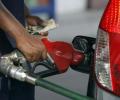
A looming global shortage of diesel in Europe presents India with more than one opportunity to profit from strong margins. A shortage of the fuel, a key contributor to inflation, has been exacerbated by the conflict in Ukraine, and western sanctions on Russian fuel supplies. The slowdown in natural gas supply means the West needs diesel to heat their homes this winter.

Savings for Indian refiners from purchasing Russian oil have decreased to a third of what they were in the years following Russia's invasion of Ukraine, which triggered global crises, sanctions, and discounted Russian oil seeking buyers. Despite this, savings from importing cheap Russian oil were significant enough to help Indian refiners tide over frozen petrol and diesel pump prices.

India and China have made "some progress" in disengagement, External Affairs Minister S Jaishankar said on Sunday, describing it as a "welcome" move which opens up the possibility that other steps could happen.

State Bank of India was the biggest gainer in the Sensex pack, rising 4.24 per cent, followed by Tata Steel, Axis Bank, Maruti, NTPC, PowerGrid, ITC and Nestle India. Reliance jumped 1.15 per cent to end at Rs 2,962.60 apiece on BSE.

India may have to lean more on West Asian nations for supplies of liquefied petroleum gas (LPG), a cooking fuel, in the coming years after Indian state-run refiners drew up big plans to diversify into producing more profitable petrochemicals. This shift leads to reduced LPG output, Indian refining executives said. The mantra for state-run oil companies, from Indian Oil Corporation (IndianOil) to liquefied natural gas (LNG) importer Petronet LNG, which are looking to diversify their businesses from lower-margin fuels, has been value-added petrochemicals.

The ruble has recouped most of its losses and become the top-performing currency globally. It continues to gain and is up 60 per cent against the US dollar from its lows in the first week of March. The ruble appreciated to 83 to the dollar intraday on Tuesday against a record low of 139 on March 7.

We no longer have the ambition to rival China save through words. We are happy to be fighting ourselves and digging up disputes from centuries ago as a substitute for real development, argues Aakar Patel.

'We have relatively strong growth and a healthy corporate earnings cycle as positives, but a worrisome current account deficit and high inflation as challenges.'

The Kerala government announced on Wednesday that the Argentina national football team, led by legendary player Lionel Messi, will visit the state next year for an international friendly match, which Chief Minister Pinarayi Vijayan hailed as a tribute to state people's passion for soccer.

Lower crude oil costs and higher marketing margins are expected to raise the fortunes of oil marketing companies (OMCs) in the first quarter (Q1) of 2023-24 (FY24), while city gas distribution (CGD) companies could also benefit from lower spot prices of liquefied natural gas (LNG). However, in a break from the past, growth trends are expected to diverge for various segments within the broad energy sector. Analysts expect the earnings from gas production to go down for upstream national oil and gas companies such as Oil and Natural Gas Corporation (ONGC) and Oil India (OIL) due to the introduction of the new domestic gas pricing regime on April 1. After showing steep losses over the first half of 2022-23 (FY23), the marketing margins of OMCs have steadily recovered in four months.

All the global transitions are working in India's favour, giving it the potential to become a force in today's uncertain world, but one of the country's biggest challenges is inclusive growth, Tata Sons chairman N Chandrasekaran said on Monday. In his address at the JRD Tata Oration, the head of the Tata group also asserted that Artificial Intelligence (AI) is here to stay and it will be beneficial if India prepares for it. Post the cold war era of relative stability and prosperity, the world appears to have given way to unpredictable conflicts and economic uncertainty, he said, adding that the pandemic resulted in supply chain shocks of gigantic proportion.

'The combination of star power, compelling storytelling, and action-packed drama promises to set the box office ablaze and kickstart the new quarter on a spectacular high note.'

Investors engaged in profit booking in the recent gainers at attractive and higher valuations.

Banks stocks continued to trade weak along with FMCG major ITC.

LIC's $2.7-billion initial public offering (IPO) shall be the fifth-biggest globally in CY22. South Korean EV battery maker LG Energy Solution holds the record for the year's largest IPO at $10.8 billion, while Chinese mobile communications provider China Mobile IPO, which raised $8.6 billion, comes second. Dubai Electricity and Water Authority's (DEWA's) $6.1-billion IPO in March is currently the third biggest public offering for the year, followed by China National Offshore Oil Corporation's (CNOOC's) IPO; the firm had raised $5.1 billion by issuing shares in Mainland China after delisting from the American bourses.

'It is less dependent on imported capital.'

Private equity (PE) investments in India have fallen to a 6-year low at $24.2 billion in the financial year ending March 2024. Investments via PE deals are down 47 per cent compared to FY23, when private equity deals worth $45.8 billion were signed. According to data sourced from Bloomberg, PE firms had signed record deals worth $80 billion in the financial year ending March 2022.

'Investors need to expect steady returns over the next one to two years with bouts of high volatility.'

Larsen & Toubro, Axis Bank, Reliance Industries, UltraTech Cement, Mahindra & Mahindra, IndusInd Bank, ICICI Bank and Tata Steel were the other big gainers. Sun Pharma, HCL Technologies, Asian Paints, Nestle and Infosys were the laggards.
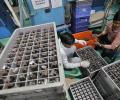
The new four-wheeler (4W) electric vehicle (EV) policy may spur the entry of global majors. The manufacturing policy cuts Customs duty to 15 per cent, given a minimum investment commitment. It calls for a minimum investment of Rs 4,150 crore (about $500 million) for making electric four wheelers (e-4Ws), with manufacturing to commence within three years of approval.

'2019 was fought on delivery. But in 2024, you can see the before and after effects.'
India's trade account could come under pressure and there could be an inflation push if crude oil prices remain above the $90 per barrel (Brent) for a prolonged period since India imports over 85 per cent of its oil and roughly 50 per cent of its gas. A rebound in economic activity is bound to lead to higher fuel demand. While India is the third-largest importer of crude, it is a net exporter of refined products, which helps to compensate to some degree.

From the Sensex firms, Wipro, NTPC, Sun Pharma, Mahindra & Mahindra, ITC and Reliance Industries were among the biggest laggards. IndusInd Bank, Axis Bank, Bajaj Finance, HDFC Bank, Larsen & Toubro and State Bank of India were among the major gainers.

The wider NSE Nifty touched a low of 10,652.40 before finishing at 10,671.40, showing a loss of 97.75 points, or 0.91 per cent.

'China is somewhat disappointing in its recovery, and slow growth, and India is reporting strong growth numbers.'

Investor sentiments remained upbeat tracking global developments as the US, China geared up for trade talks due this week.

The combined market capitalisation of Adani group companies increased to Rs 15.11 trillion last week. As a result, Gautam Adani's family raced ahead of Mukesh Ambani of Reliance Industries, reclaiming the title of India's wealthiest promoter.

Prime Minister Narendra Modi on Thursday thanked Qatari Emir Sheikh Tamim bin Hamad Al-Thani for the release of eight Indian nationals, who were sentenced to death after being arrested in Doha in August 2022.

Adani Group on Thursday said it has formed a 50:50 joint venture with Japanese conglomerate Kowa Group for sale of green hydrogen in Japan, Taiwan and Hawaii markets. Billionaire Gautam Adani-led conglomerate is investing up to $50 billion over the next 10 years in setting up a fully integrated green hydrogen ecosystem in India. This includes the production of 1 million tonne of green hydrogen in the initial phase which will be ramped up to 3 million tonne later.

Earnings growth, attractive valuations and change in FPI flows from negative to positive over the next 12 months are some of the key triggers for an upside. "A poor monsoon, high inflation and further rate hike are some of the key risks
Billionaire Mukesh Ambani-led Reliance Industries Ltd's plans for investing Rs 75,000 crore in solar, batteries, fuel cells and hydrogen could create valuation of $36 billion (Rs 2.6 lakh crore) for the new energy business, Wall Street brokerage Bernstein Research said in a report. Reliance currently has three verticals -- oil-to-chemical (O2C) business that houses its oil refineries, petrochemical plants and fuel retailing business; digital services that comprises telecom arm Jio; and retail including e-commerce. New Energy will be the fourth vertical. At the company's annual general meeting of shareholders last month, Ambani announced a plan to invest Rs 75,000 crore in a new energy business over the next 3 years in the next stage in its transformation.

The S&P BSE Midcap and the S&P BSE Smallcap indices have managed to stay afloat in a volatile January that saw the frontline indices hit their respective 52-week high levels and then slip. While the S&P BSE Sensex has lost over 2 per cent thus far in January, the S&P BSE Midcap and the S&P BSE Smallcap indices have gained nearly 2.5 per cent and 4 per cent, respectively during this period.

The market capitalisation of BSE-listed companies jumped to a lifetime peak of Rs 404.18 lakh crore on Thursday helped by a five-day rally in benchmark indices, making investors richer by Rs 11.29 lakh crore. Recovering after a sell-off in early trade, the 30-share BSE Sensex climbed 486.50 points or 0.66 per cent to settle at 74,339.44 on Thursday. During the day, it surged 718.31 points or 0.97 per cent to 74,571.25.
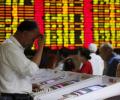
Chinese brokers had been looking to use some of the cash they raised this year to expand their global reach

The 30-share Sensex ended in the red.

ITC was the top loser in the Sensex pack, shedding 1.97 per cent, followed by Tata Steel 1.80 per cent, HUL 1.57 per cent, Vedanta 1.44 per cent, Bharti Airtel 1.37 per cent and M&M 1.35 per cent.

Mondelez, Coca-Cola, PepsiCo and Nestle India have been working on bringing down the sugar, salt, and sodium content.

After a turnaround in performance by Indian equity markets since July that has seen the S&P BSE Sensex and the Nifty50 wipe out the year-to-date losses, analysts suggest investors start nibbling into stocks that are focused on the domestic economy. While they say intermittent corrections, led by policies of global central banks and other economic data, cannot be ruled out, analysts expect India's relative outperformance among global equity markets to continue as it looks better placed with a healthy economic recovery, and remains one of the fastest growing major economies. In this backdrop, Neeraj Chadawar, head of quantitative equity strategy at Axis Securities, believes that amid global slowdown, aggressive tightening by the central banks, and preference for domestic interests first (by the local government), export-oriented themes are likely to be muted or will deliver conservative returns in the near-term.
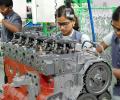
Genset manufacturer Cummins India has seen its share price rise by 45 per cent in the past three months. The management has reaffirmed that growth would be in double digits over the coming two fiscal years. Growth is expected to be driven by a pickup in domestic infrastructure spending.
